project details
Duration: 8 weeks
My role: Sole product designer responsible for the UX/UI process, from initial research and persona development through final prototyping
overview
Dog owners rely on memory alone to detect patterns. But when it's time to visit the vet, owners struggle to provide concrete, time-anchored details that could help diagnose problems more quickly. This gap between caring deeply and having the tools to act on that care leaves owners uncertain about whether their dog is truly thriving.
Source¹: Ostermeier, N. (2022, August 9). How collaborating with pet owners leads to better veterinary patient outcomes. The Vetiverse. https://www.thevetiverse.com/en/latest/how-collaborating-with-pet-owners-leads-to-better-veterinary-patient-outcomes/
research methodology
My primary research focused on:
Identifying key competitors (Woofz and DogNote) and an indirect competitor (Apple Notes) to uncover gaps in existing solutions and opportunities for sova to differentiate itself.
Conducting remote interviews with 5 dog owners through Maze, exploring four key areas: their goals and priorities as dog owners, their current behaviors around dog care, the tools they use(or don't use) to track health and routines, and their biggest frustrations.
competitor analysis
Researching the dog care space and existing apps on the market
I explored existing dog care apps and other logging tools, trying them out myself and focusing on their ease of use and ability to support daily health observations.
Strengths
Woofz

User-friendly interface with a cute animated design and clear instructions that are easy to navigate.
All-in-one hub with a wellness dashboard to track a dog's wellbeing, monitor daily activities, and receive personalized tips.
Multiple features, including a walking tracker, a calendar for scheduling, a photo gallery for precious moments, and an in-app clicker for training.
Text entry available within specific features for contextual notes on training progress and activities.
DogNote

The family system enables seamless coordination among multiple caretakers through shared updates on feeding, medication, vaccinations, and milestones.
Text notes can be attached to logged events for additional context.

Weaknesses
DogNote
Reminders are not tasks with checkboxes; users must manually create events to mark completion, adding extra steps.
No pattern recognition. Cannot identify trends or patterns in pet health observations (energy levels, appetite changes, behavior) that might indicate emerging health issues.
Notes
No pet-specific structure. Generic note-taking requires users to manually create and maintain their own organizational system for tracking pet care, health, and memories without any built-in templates or guidance.
No pattern recognition. Cannot identify trends or patterns in pet health observations (energy levels, appetite changes, behavior) that might indicate emerging health issues.
Uncovered opportunity: Quick daily health check-in
Dog owners lack a frictionless way to log daily health observations, meaning early warning signs go unnoticed. Woofz, DogNote, and Notes all miss this: they're either too complex, too manual, or too unstructured for quick daily use. This revealed an opportunity to create a simple way for owners to log health observations, transforming casual observations into trackable data.
AFFINITY MAPPING

Finding 1: Dog owners lack a structured system to capture observations
Dog owners naturally observe their dogs' health daily through behavioral cues (energy, appetite, bathroom habits) but lack a structured system to capture these observations over time.
Finding 2: Dog owners are proactive about their dog's health
While owners are deeply motivated to be proactive about their dog's health, current digital apps require that health observations be attached to predefined events, adding friction to quick check-ins.
The problem
Dog owners need a simple, quick way to log daily health observations and visualize patterns over time because memory-based health monitoring makes it difficult to spot gradual changes, leading to missed early warning signs and uncertainty about whether their dog is truly thriving.
The solution
Based on research insights, I designed a dog health app with quick check-ins for logging key health indicators. The app also visualizes trends over time to help owners identify patterns and potential issues.
User flow
I mapped out the end-to-end user flow to define the touch points to create.
I focused on creating user flows for three core interactions: the check-in process for logging daily health observations, adding and completing a task, and editing a dog profile. These flows were designed to be as frictionless as possible to help them avoid abandoning the process.
In my usability testing, the tested user flow was completing a health check-in.

IDEATION
Making daily check-ins simple and visible
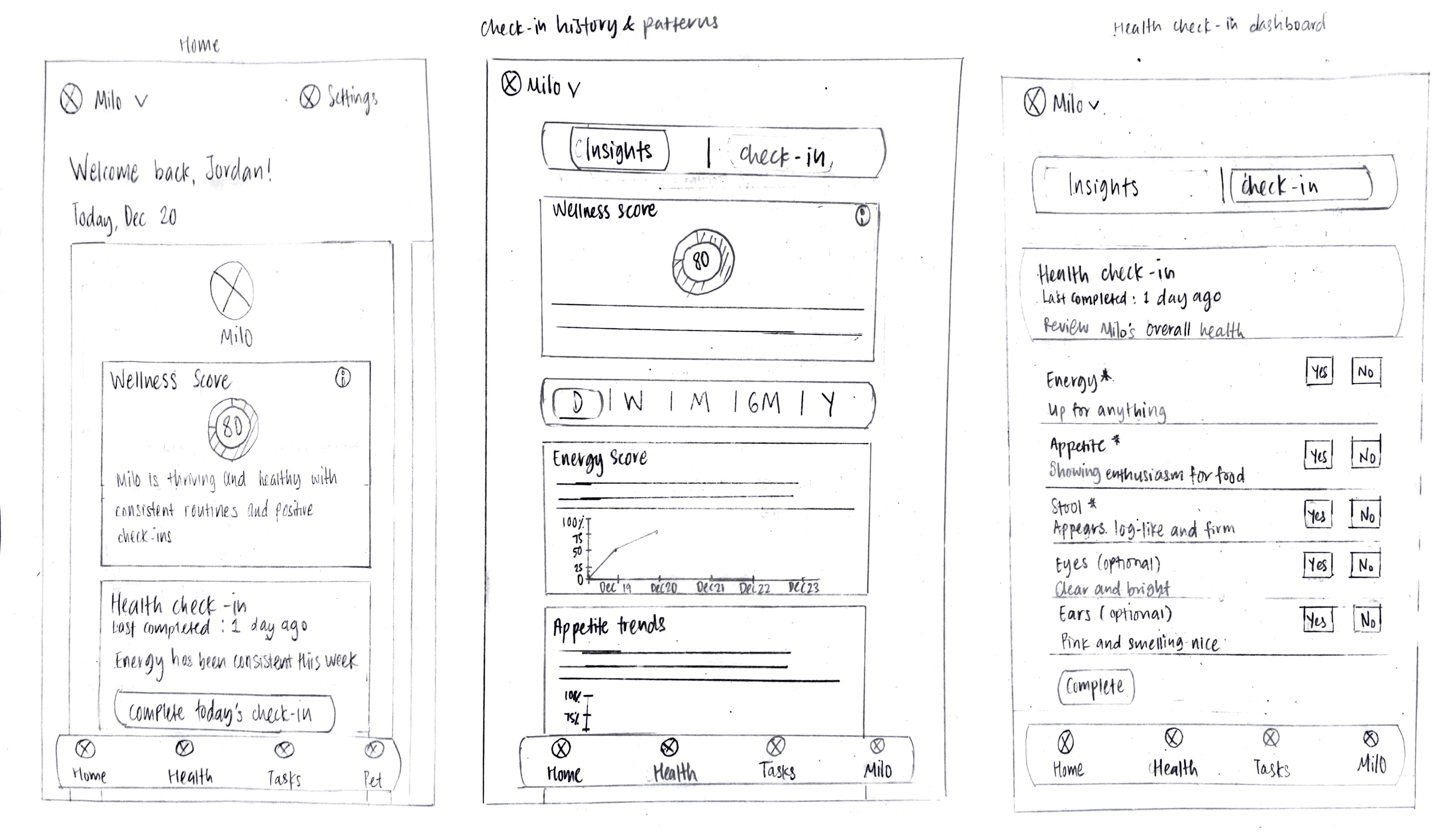
Drawing from my research, I kept simplicity at the center of every decision. The check-in needed to be quick and effortless, not buried under menus or extra steps. To reinforce this, I made it visible directly on the dashboard, prompting owners to log daily without having to seek it out. I also introduced a wellness score to give owners a motivating metric to maintain over time.
Design System
Calm, trustworthy, and approachable
sova's visual language is grounded in warmth and simplicity, reflecting the quiet, attentive nature of the app and helping dog owners feel informed and at ease rather than overwhelmed.

high-fidelity wireframes
Screens designed to make health tracking feel effortless
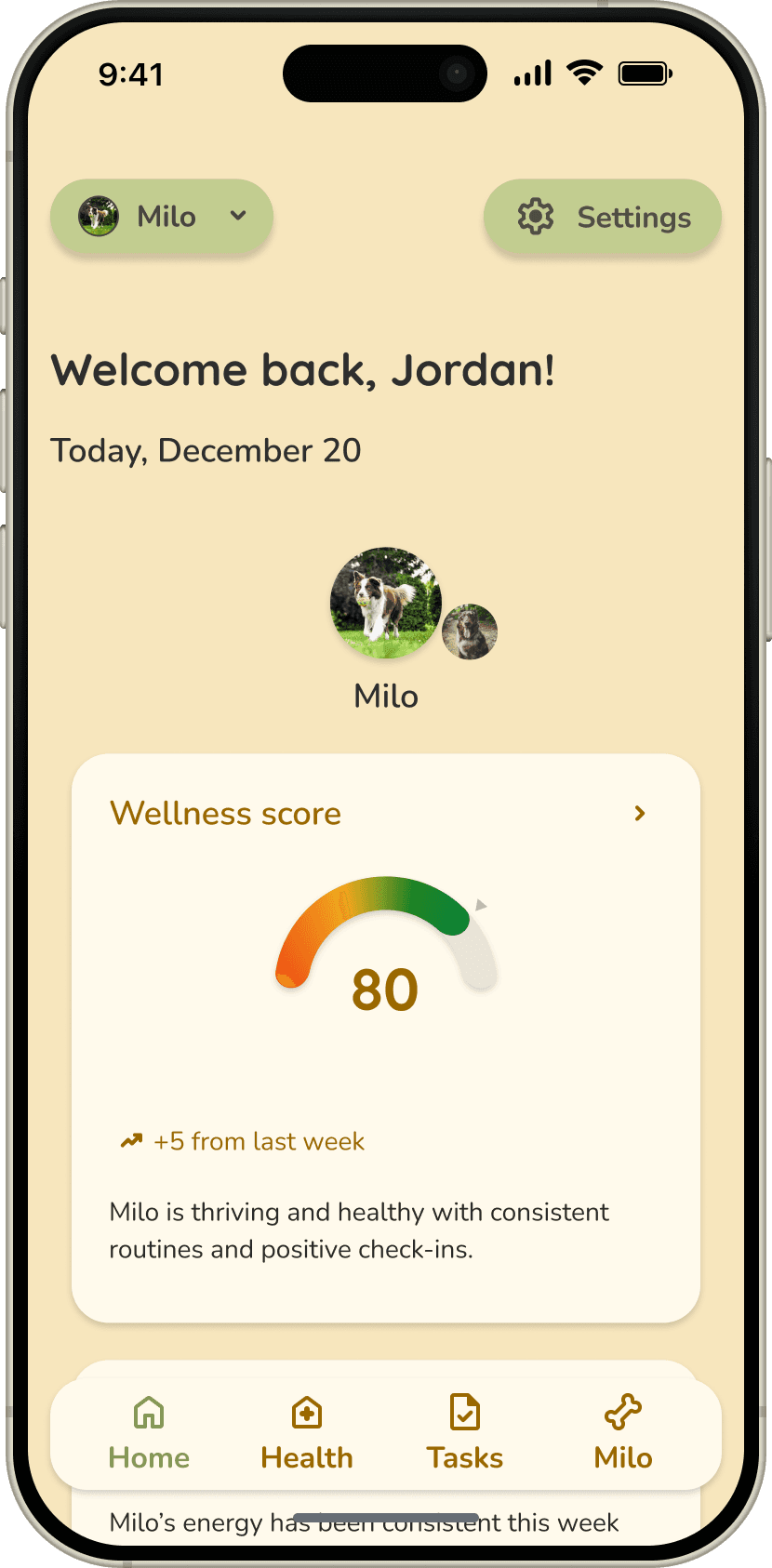


With the design system in place, I translated the component library into three core screens: the Home dashboard, the Insights tab, and the Health check-in flow.
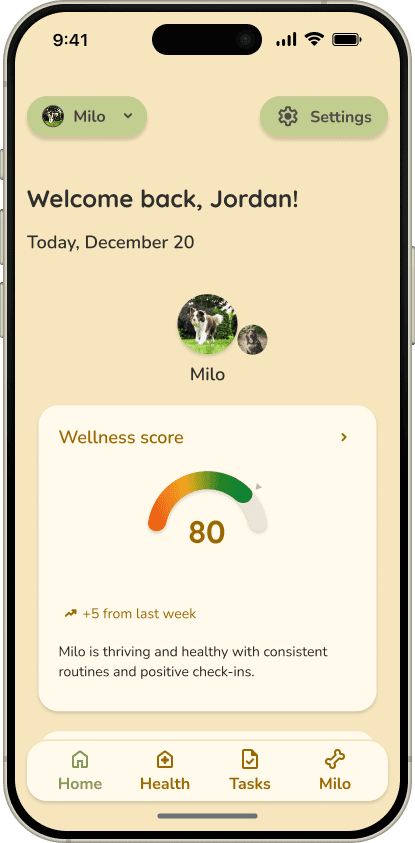
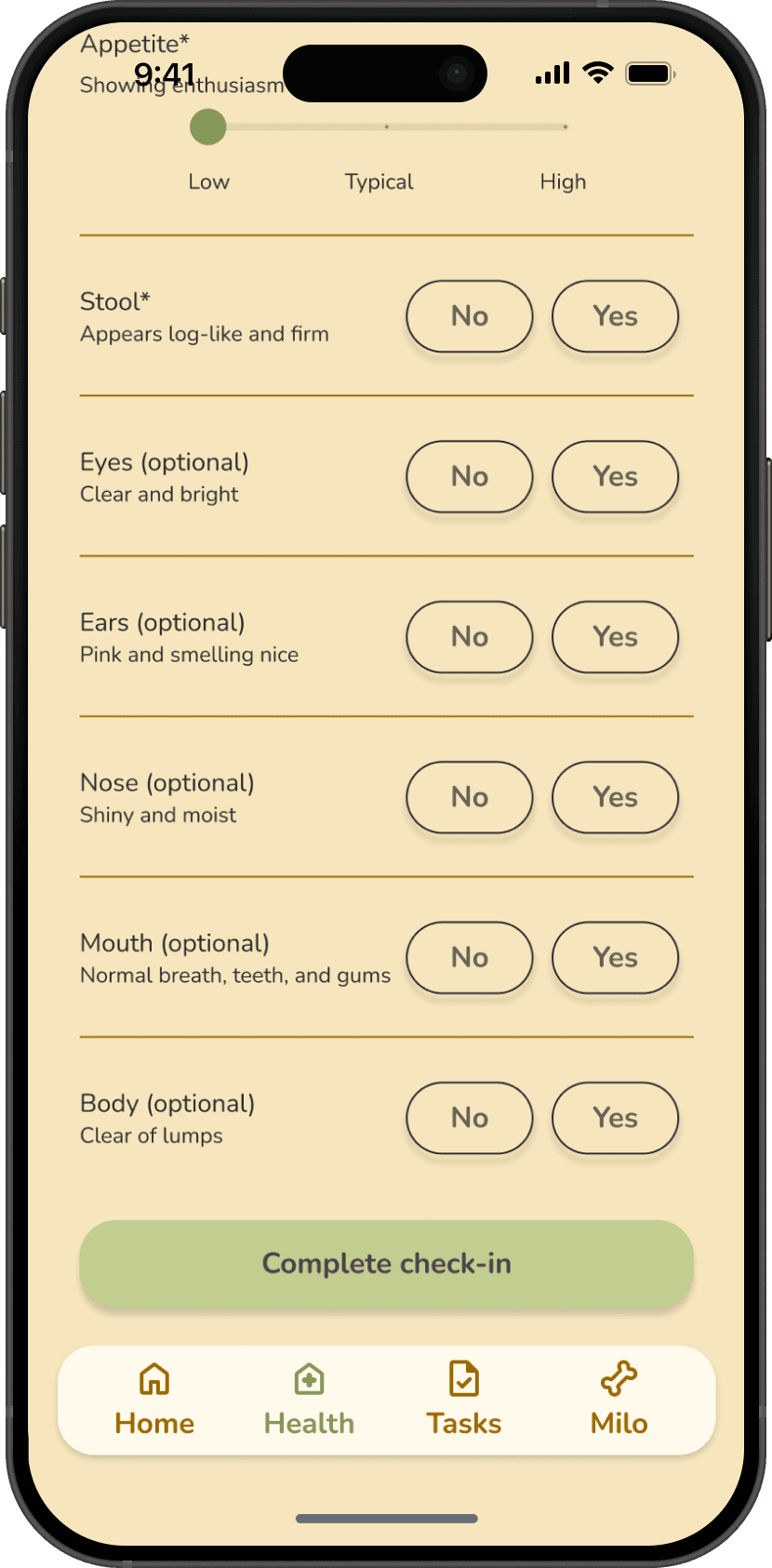
The home dashboard greets users by name and surfaces Milo's wellness score at a glance. The Insights tab lets users explore patterns like energy levels across different time ranges. The Check-in flow breaks health logging into simple, low-friction inputs, making it easy to complete in under a minute.
usability testing
The goal of this study was to understand how easily users can navigate the health check-in feature, interpret insights, and perceive value from health tracking over time.
The test was conducted through Maze with 5 participants who own one or more dogs, regularly observe their dog's behavior or health indicators, have busy or demanding schedules, and can use mobile apps comfortably.
tested flow: Health check-in
Pattern visualization and insights
Health insights that surface trends over time, helping dog owners spot deviations.
Quick daily health check-ins
Fast check-in feature for logging health indicator observations.
USABILITY TESTING key insights
Desire for richer documentation through multimedia notes
Participants want the ability to add notes, photos, and videos to provide richer context beyond structured fields, improving documentation and veterinary support.
Validated alignment with users’ pet health monitoring goals
The majority of participants said the system clearly reflected their dog’s status and changes over time, helping address the gap of owners relying on memory to notice subtle health shifts.
design iteration
Supporting notes and media attachments for accurate documentation
Before
After

Utilizing the impact-effort matrix, this high-impact, low-effort improvement was prioritized to improve documentation accuracy and help users capture richer context when logging health observations.
reflection
What I learned
Avoid assuming the solution too early
Early in the project, I assumed a journaling app for dog memories would be valuable. However, research showed users were more interested in tools for monitoring and understanding their dog’s health. This reinforced the importance of letting research define the problem before committing to a solution.
Validate language and tone earlier with users
I would test the language and tone used in health insights earlier in the design process to ensure they felt supportive, clear, and non-alarming. Because health-related information can easily be misinterpreted, earlier validation of wording and labels could have helped confirm that insights were reassuring and actionable without increasing anxiety.